Two programmers Caleb Philips and Ethan Weltys have created an interactive global foraging map that shows that allows you to find fruits, vegetables, nuts, berries and lots of other healthy edible plants in public parks, urban farming projects, lining city streets, and even hanging over fences (and, therefor, onto the public domain of sidewalks).
The project, dubbed "Falling Fruit" identifies more than a half-million locations across the globe where fruits and veggies are FREE for the taking.
In practice, the Falling Fruit maps look like a typical Google map with foraging locations represented by dots. Zoom in and click on one, and up pops a box with a description of what tree or bush you can find there. The description often includes information on the best season to pluck the produce, the quality and yield of the plant,
Link to the Website: Falling Fruit
The Documentary "Food Cartographers,” directed by Jamie Schutz, follows Ethan Welty and Caleb Phillips in their venture.
Monday, March 2, 2015


Thursday, December 25, 2014
The Suspended Coffees Movement
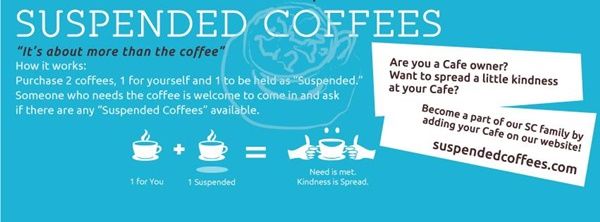
There's an old tradition in Naples, Italy called 'Caffè Sospeso' where someone who is pretty well off would buy a coffee and an extra cup which was suspended for someone less fortunate.
The cafe kept a log of the number of "suspended coffees" that had been bought and gave them out to people who couldn't afford them; a simple but lovely idea.
That great tradition was the inspiration for Cork man John Sweeney's Suspended Coffees Movement, which is now in operation in over 1,800 coffee shops in 20 countries in the world.
But it really is about so much more than the coffee. It can provide physical comfort, conversation, a smile or even a laugh, and a sense of belonging. A suspended coffee can change lives, sometimes even save them.
Link to website: suspendedcoffees
Thursday, December 11, 2014
China's Rat Tribe
“Rat Tribe” explores the lives of low-waged migrant workers who live underground in Beijing and make up one-third of the city’s estimated 20 million people. These waiters, karaoke hostesses, hairdressers, chefs, security guards, domestic workers and kitchen helpers are the backbone of Beijing’s service industry. But they have been unkindly dubbed the “rat tribe” for making a home in Beijing’s 6,000 basements and air raid shelters — about one-third of the city’s underground space.
Photographer Sim Chi Yin spent two years shooting members of the capitol’s so-called “rats.” “
Monthly rent for a single that sleeps two and three people can range between an affordable 300 and 700 renminbi (about $50 and $100). But kitchens and bathrooms are communal. Hallways are dank, dark, and airless.
The spending of the rich and famous, meanwhile, is insatiable. Consultancy McKinsey & Company forecasts that China will dominate more than one-third of worldwide luxury spending by 2015, a stark comparison to an urban underbelly populated by people referred to as rats.
China's Rat Tribe, by Sim Chi Yin from Invisible Photographer Asia on Vimeo.
Photographer Sim Chi Yin spent two years shooting members of the capitol’s so-called “rats.” “
The spending of the rich and famous, meanwhile, is insatiable. Consultancy McKinsey & Company forecasts that China will dominate more than one-third of worldwide luxury spending by 2015, a stark comparison to an urban underbelly populated by people referred to as rats.
China's Rat Tribe, by Sim Chi Yin from Invisible Photographer Asia on Vimeo.
Sunday, December 7, 2014
The Hour of Code - WORLDWIDE

The Hour of Code is a global movement reaching tens of millions of students in 180+ countries. It is a one-hour introduction to computer science, designed to demystify code and show that anybody can learn the basics. Anyone, anywhere can organize an Hour of Code event. One-hour tutorials are available in over 30 languages. No experience needed. Ages 4 to 104. Last year 15 million students worldwide learned an Hour of Code.
The Hour of Code is organized by Code.org, a public 501c3 non-profit dedicated to expanding participation in computer science by making it available in more schools, and increasing participation by women and underrepresented students of color. An unprecedented coalition of partners have come together to support the Hour of Code, too — including Microsoft, Apple, Amazon,Facebook, Google, Yahoo, Linkedin etc.
JOIN THE LARGEST LEARNING EVENT IN HISTORY, DEC 8-14, 2014. SIGN UP to host an Hour of Code event here- http://hourofcode.org/ and start planning. You can organize an Hour of Code event at your school or in your community like in an extracurricular club, non-profit or at work. Or, just try it yourself when Dec. 8 arrives.
Thursday, November 20, 2014
Fresh Prescription
Instead of pills, doctors prescribe fruits and vegetables through program that unites health care with local food systems
The typical idea of treating diseases in this country consists of seeing a doctor, who then prescribes medication, says Dr. Richard Bryce, a senior staff physician in the Department of Family Medicine at Henry Ford Hospital who works full time at CHASS.
With Health Rx, he has the option of telling patients, “Here are meds. These are good meds but there’s a lot of side effects that go along with them, and if we can fix this problem with just nutrition and exercise you’ll feel better and you’ll be helping your health in general overall.”
Connecticut-based nonprofit Wholesome Wave, founded by a James Beard award-winning chef in 2007, created the Fruit and Vegetable Prescription Program that reached more than 5,000 low-income families between 2010 and 2014.
Health Rx, a partnership between the Ecology Center and CHASS, aims to increase consumption of fruits and vegetables as a way to manage chronic diseases. CHASS, which piloted the program last year, had 45 participants in 2013. This year, they have the capacity to reach 140 people who receive a total of $40, distributed through debit cards, to be used in $10 increments at the farmers market held every Thursday at CHASS.
Read the entire original article in Hour Detroit by DOROTHY HERNANDEZ in the link below..
Fresh Prescription - Hour Detroit
The typical idea of treating diseases in this country consists of seeing a doctor, who then prescribes medication, says Dr. Richard Bryce, a senior staff physician in the Department of Family Medicine at Henry Ford Hospital who works full time at CHASS.
With Health Rx, he has the option of telling patients, “Here are meds. These are good meds but there’s a lot of side effects that go along with them, and if we can fix this problem with just nutrition and exercise you’ll feel better and you’ll be helping your health in general overall.”
Connecticut-based nonprofit Wholesome Wave, founded by a James Beard award-winning chef in 2007, created the Fruit and Vegetable Prescription Program that reached more than 5,000 low-income families between 2010 and 2014.
Health Rx, a partnership between the Ecology Center and CHASS, aims to increase consumption of fruits and vegetables as a way to manage chronic diseases. CHASS, which piloted the program last year, had 45 participants in 2013. This year, they have the capacity to reach 140 people who receive a total of $40, distributed through debit cards, to be used in $10 increments at the farmers market held every Thursday at CHASS.
Read the entire original article in Hour Detroit by DOROTHY HERNANDEZ in the link below..
Fresh Prescription - Hour Detroit
Sunday, October 19, 2014
BIONEERS: Restoring the Earth and its People

Bioneers is a fertile hub of social and scientific innovators with practical and visionary solutions for the world's most pressing environmental and social challenges.
It arose from three principal streams of work: Biological and cultural diversity, Biomimicry, Natural medicine
Founder Kenny Ausubel coined the term Bioneers in 1990 to describe an emerging culture. Bioneers are social and scientific innovators from all walks of life and disciplines who have peered deep into the heart of living systems to understand how nature operates, and to mimic "nature's operating instructions" to serve human ends without harming the web of life. Nature's principles—kinship, cooperation, diversity, symbiosis and cycles of continuous creation absent of waste—can also serve as metaphoric guideposts for organizing an equitable, compassionate and democratic society.
Since 1990, Kenny Ausubel and Nina Simons have been assembling Bioneers for an annual conference, a gathering of scientific and social innovators who have demonstrated visionary and practical models for restoring the Earth and communities.
Bioneers' Founding Perspectives
Natural Medicine. Nature has a profound and profoundly mysterious ability for self-repair. The primary source of healing lies in nature. In environmental restoration as in medicine, the role of the practitioner is to support nature to heal itself. This principle became foundational to Bioneers.
Nature’s Solutions. Nature has solved all the ecological challenges we’re trying to address. Practitioners such as John Todd, Amory Lovins, Wes Jackson and Donald Hammer, as well as traditional indigenous practices, were a primary inspiration. In 1997, naturalist and author Janine Benyus gave this emerging science a name in her landmark book Biomimicry: Innovation Inspired by Nature, the same year she first spoke at Bioneers. Biomimicry has been a core focus since Bioneers’ inception.
Biocultural Diversity. In nature, diversity is the very fabric of life. Because change is the only constant in nature, diversity is the source of resilience to adapt to change in both natural and human systems. Successful adaptation requires keeping open the greatest range of biologically and culturally diverse options.
From the Mission Statement of Bioneers:
"Founded in 1990 in Santa Fe, New Mexico by social entrepreneurs Kenny Ausubel and Nina Simons, Bioneers has acted as a fertile hub of social and scientific innovators with practical and visionary solutions for the world’s most pressing environmental and social challenges. A celebration of the genius of nature and human ingenuity, Bioneers connects people with breakthrough solutions and each other. Our acclaimed annual national and local conferences are complemented by extensive media outreach including an award-winning radio series, book series, and role in media projects such as Leonardo DiCaprio’s film The 11th Hour. Our programs further focus on Women’s Leadership, Indigenous Wisdom, Community Resilience Networks, and Leadership Development and Youth.
Our work has evolved into six programs:
Changing the Mindscape. A Public Education program that features the Bioneers conference(s) and extensive media production and outreach, including an award-winning radio series, book series, satellite and TV broadcasts and a consulting role for third-party films, press and media. Watch for the new Media component on our web site this year.
Education for Action. A Formal Education program that acts as a hub for educators and students, and brings Bioneers Education for Sustainability (EfS) materials to schools and colleges. We work with specific groups and institutions to leverage educational systems for social transformation.
Resilience from the Ground Up. A Localization program that works through the award-winning Dreaming New Mexico project to bring a practical toolkit and methodology for effective systemic change at the municipal and state level, and that other communities can customize.
Every Woman's Leadership Initiatives. A whole systems approach to diverse Women’s Leadership that provides experiential education and media to strengthen women’s capacity to be bold, congruent and effective leaders on behalf of a healthy, just and peaceful future. The program encourages all people toward “full-spectrum leadership,” with flexible access to all of our feminine and masculine qualities.
Becoming Native to Place. An Indigeneity program that educates people about the essential practices of indigenous and traditional knowledge. We invite people to learn with leadership from First Peoples how to re-indigenize our societies as citizens of planet Earth and our local address.
Bioneers Global. An international program to connect social and scientific innovators for the purposes of network cultivation, cross-pollination and the transfer of effective practices, models, technologies and key ideas."
Link to Bioneers: http://www.bioneers.org/
The House of One in Berlin: A Mosque, Synagogue, and Church—All Under the Same Roof

In Berlin something unique is created, the House of One: the world´s first common house of prayer and learning built for Jews, Christians and Muslims - synagogue, church and mosque under one roof. A house in which a shared central space gives room for encounter and discussion. A house of dialogue, understanding and peace.
Pastor Gregor Hohberg first put forward the idea of multi-faith building, and Rabbi Tovia Ben-Chorin and Imam Kadir Sanci have now joined him in the project. Each religion will have its own practice space, all equally sized but with different designs. There will also be a central room connecting the prayer rooms and providing an area where Christians, Muslims, and Jews can all meet, along with those of other faiths.
In 2012, local architect Wilfried Kuehn won a competition to design the building. Construction will begin next year and the doors will open in 2018. To raise money for construction a crowdfunding campaign is under way, with a target of $58.6 million.
Become a part of this hope-giving idea and help building The House of One. Here is the link
http://house-of-one.org/en
Sunday, October 12, 2014
Introducing slow Jo: The Slow Watch That Help Us Reimagine Our Relationship With Time

In a time when our phones are fast becoming our clocks and watches, and displaying the exact time, down to the minute, is just a click away, we're more aware than ever before that time is ticking away.
But do we really need to always know the exact time, or does it just stress us out and keep us from living in the moment? According to Slow, because of our busy lifestyles, "we often forget that we actually have a choice of how to live," and their reinvention of the watch helps us put our own time in perspective.
A different kind of wristwatch, the Slow Watch, aims to help us reimagine our relationship with time, by putting it into context and allowing us to visualize our entire day. First launched last year, and sold only online, the first of the Slow Watches (the Slow Jo) displays the entire 24 hour time cycle on the face of the device, and uses just a single hand to indicate the time, letting us focus on the moment, not the never-ending march of seconds.
"The slow watch is a subtle reminder that time is the most precious thing we have so we should enjoy everything we do and stop chasing every minute. In order to be a true symbol of this idea, the slow watch has only one hand that rotates once every 24 hours. It actually moves at half the speed of a normal watch, but allows you to see the progress of your entire day at a glance." - Slow
LINK: https://www.slow-watches.com/the-product
Subscribe to:
Posts (Atom)