Monday, December 30, 2013

World’s First Vertical Forest Gets Introduced in Italy

World’s First Vertical Forest Gets Introduced in Italy (via greenliving4live.com)

See on Scoop.it – Green Living The Bosco Verticale is a system that optimizes, recuperates, and produces energy. Covered in plant life, the building aids in balancing the microclimate and in filtering the dust particles contained in the urban environment…

Ariel Sharon Park, A Revolution In Waste Management & Urban Planning

Ariel Sharon Park, A Revolution In Waste Management & Urban Planning (via Planetsave)

What do you do if you have a lot of trash, limited landfill space, problematic floodplains, and a growing population? It’s a common problem across the world, as the trends of population growth, wasteful consumption and an increasingly plastic, throwaway…

Wednesday, November 27, 2013

Cicada 3301: The internet mystery that has the world baffled


One evening in January last year, Joel Eriksson, a 34-year-old computer analyst from Uppsala, Sweden, was trawling the web, looking for distraction, when he came across a message on an Internet forum.

The message was in stark white type, against a black background.

“Hello,” it said. “We are looking for highly intelligent individuals. To find them, we have devised a test. There is a message hidden in this image. Find it, and it will lead you on the road to finding us. We look forward to meeting the few that will make it all the way through. Good luck.”

The message was signed: “3301.”

A self-confessed IT security “freak” and a skilled cryptographer, Eriksson was interested immediately.

This was, he knew, an example of digital steganography: the concealment of secret information within a digital file, most often seen in conjunction with image files.

A recipient who can work out the code — for example, to alter the colour of every 100th pixel — can retrieve an entirely different image from the randomized background “noise.”

It’s a technique more commonly associated with nefarious ends, such as concealing child pornography. In 2002 it was suggested that al-Qaida operatives had planned the Sept. 11, 2001 attacks via the auction site eBay, by encrypting messages inside digital photographs.


Read more in the original article at the link below..
The internet mystery that has the world baffled

Friday, November 8, 2013

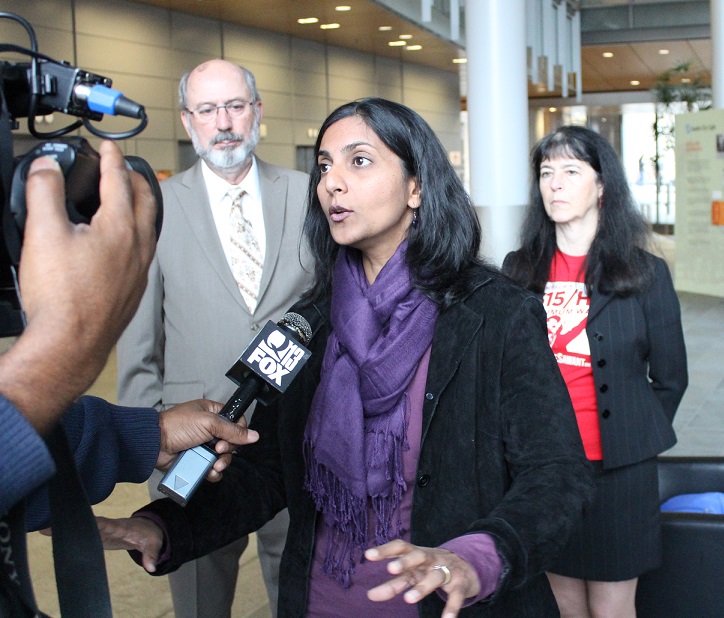
Why Socialist Kshama Sawant's Campaign Matters To Seattle


Kshama Sawant didn’t have to identify as a socialist.

Seattle City Council races are nonpartisan, after all, and her views aren’t particularly revolutionary, as far as Seattle goes: She supports a $15 minimum wage (as do both mayoral candidates), unions for low-wage workers and rent control.

But branding herself as a socialist – still a dirty word in many corners of American politics – may have helped her rake in 35 percent of the primary vote with little money. (She had raised about $110,000 as of Monday night.)

Councilmember Nick Licata, who has been on the council for 16 years, said Sawant’s message resonates because a section of voters are tired of risk-averse Democrats and Republicans. Sawant, he said, has managed to make socialist ideas appeal to voters.

“We don’t have a mature socialist political movement in the country, and probably the last time we did was literally 80 years ago,” Licata said. “To Sawant’s credit, she has been able to craft a message that is understandable, simple and eschews most of the rhetoric.”

Sawant ran against Richard Conlin, 64, a darling of the Democratic party with left-leaning views. Conlin appeared to be winning on Tuesday night with 54 percent of the vote when King County released its first results. Sawant received about 46 percent of the vote.

Sawant stayed on message throughout her campaign, using dry, academic language to discuss the issues she wants addressed. The roots of homelessness are within the roots of our capitalist society itself, she said at the October debate.

Later, on the social media site Reddit, she addressed rent control:
What rent control would do is provide housing security for tenants, who are at present continually forced to move due to rent increases demanded by price-gouging real estate companies. It would also address the serious income and race segregation in Seattle housing and enable low-income people, people of color, and immigrant communities to not be red-lined out of the city.
It appears that Sawant, 41, won support on the strength of her message alone. She is a Mumbai-educated economics professor who rarely strays from her platform and who avoids discussing her private life – although she has grudgingly admitted that she is separated from her husband. She doesn’t wear pantsuits or coiffe her hair, and she rarely points to her past experiences or to endorsements.

Sawant’s political campaign director, Philip Locker, an organizer for the Socialist Alternative party, said that by running for office, Sawant pushed neglected issues into the spotlight.

“We’ve gotten an enormous response – we’ve even forced both Mayor Mike McGinn and Sen. Ed Murray to discuss the $15 minimum wage,” Locker said of the mayoral candidates. “That’s powerful.”

When Sawant speaks, her supporters cheer. The Stranger has endorsed her enthusiastically, and The Nation magazine, based in Washington, D.C., wrote about her this week in equally glowing terms.

The Nation noted that Eugene V. Debs, the socialist candidate for president in 1912, received more than 10 percent of the vote in the Western states, including Washington.

Sawant’s campaign in Seattle speaks to a similar sense of disgruntlement with the two-party system, The Nation wrote, saying that a “bold rejection of austerity has significant popular appeal.”

But even a century ago, when Debs won more than one million votes nationwide, no socialist was this close to winning a city council position in Seattle, Scott Cline, the city’s archivist said.

City council elections have been nonpartisan since 1910, Cline said, but “I have never seen any records that indicate a city council member has self-identified as a socialist or belonged to a socialist party.”

Cline said that before 1910, a number of socialist candidates ran, but none seem to have made it out of the primary elections.

“It is certainly possible that after 1910 there might have been a serious socialist challenge,” Cline said in an email to KUOW. “However, no name from general elections stands out as a strong socialist candidate; certainly not on par with Kshama Sawant.”

Cline searched through the available voters’ pamphlets dating back to 1983 and found there has been just one other socialist candidate for Seattle City Council who did well – Yolanda Alaniz. Alaniz came in second among four candidates in 1991. She lost to Sue Donaldson, 131,872 to 27,991.

“Nevertheless, nearly 28,000 votes is quite amazing for a socialist candidate,” Cline said.
Licata said he believes that Sawant won’t be an anomaly and that more fringe candidates — on the left and the right — will run for office in coming years.

“My hope is that she doesn’t disappear after the election if she loses,” Licata said on Monday, before Tuesday night's results. “She represents the poor, the immigrants, the refugees – the folks who are not in our City Council offices lobbying us.”

On Tuesday night, Sawant told her supporters that she's not going anywhere. She hinted that she might run against Conlin again if she loses. And she said that she views the passing of the $15 minimum wage in SeaTac as evidence of the left rising up.

kuow.org
Original article: http://kuow.org/post/why-socialist-kshama-sawants-campaign-matters-win-or-lose

Thursday, November 7, 2013

Meal Sharing: A new social-networking site that connects you with a home-cooked meal wherever you are

While home cooked meals may not have been easy to come, they are now. Meal Sharing is a new social-networking site founded by Chicagoan Jay Savsani that aims to hook travelers up with hosts for home-cooked meals.

Their mission is to allow travelers to experience further. Meal Sharing wants to “make it possible for people, who otherwise would probably never meet, to get together and have a good time over food…to make that experience safe and enriching for everyone involved.”

It’s relatively easy. Here’s how it works:
You log onto the site, select your current location, and request a meal prepared by a particular host on a particular date. After a nearby host family has accepted your request, the two parties can message back and forth to detail the particulars (possible dietary restrictions, allergies, etc), and just like that, the meal is set. “To build trust and safety for the site” users log back onto the site following the meal, and write a review of their experience.

Here is the link to their site: www.mealsharing.com

Sunday, October 27, 2013

Venezuela Opens Deputy Ministry For The Supreme Social Happiness To Keep Track Of Social Programs

President Nicolás Maduro announced on Friday the creation of the Viceministerio para la Suprema Felicidad Social – a deputy ministry for the supreme social happiness. The institution will take care of complaints and applications to the services, and will monitor who is receiving what program and how it is being carried out.

The new institution will supervise the social programs the country has initiated since 2003, called Misiones. Such programs give free health care to the poorest citizens, help to the elderly and disabled, and access to education. When they launched, the Misiones gave Chávez’s presidency a much needed boost. Read the entire article here...
Venezuela Opens Deputy Ministry For The Supreme Social Happiness To Keep Track Of Social Programs

Sunday, October 20, 2013

The Story Of Marinaleda, Spain's Thriving Model Communist Village


Despite the “big” failures of 20th century Communism, the 21st century boasts plenty of smaller, enduring victories against the neoliberal order. Marinaleda is one of those victories. Few of us have heard of Marinaleda, a small town of 2700 people, tucked away in Spain’s Andalusia region, around 100km east of Seville. The town’s official coat of arms states “Marinaleda – Una Utopia Hacia La Paz” (a Utopia towards Peace).

They are led by their charismatic mayor, Juan Manuel Sánchez Gordillo, who has held the position since 1979 – re-elected time after time with an overwhelming majority.  In 2012, he became a household name in Spain after heading raids on local supermarkets to feed the Andalusian unemployed.  Mr Sánchez Gordillo’s CUT-BAI party belongs to the Izquierda Unida (“United Left”),the Communist-led coalition.

The fascinating story of this town in Southern Spain furnishes us with evidence of an embryonic, functioning, democratic socialism, which has managed to effectively struggle against the poverty and immiseration experienced in the surrounding areas of Andalusia. In Marinaleda, the residents have won and guaranteed greater rights for themselves – to pay, to housing and to facilities.

The core of Marinaleda’s communist ethic is a 1,200 hectare co-operative farm that was won through a decade of occupations and hunger strikes from the Duke of Infantado. The Duke’s property was just one of many instances in Spain of vast estates with arable land fenced off from the area’s surrounding, usually starving, population. The farm, known as El Humoso, sells its products internationally. Fair-trade and “socially aware” brands often get a bad rap by critical theorists. But El Humoso makes a compelling counterpoint to the likes of Starbucks and Tom’s Shoes. “Know that when you consume any product from our co-operative, you are helping to create employment and social justice,” says Gordillo.

The eight agricultural co-operatives on the farm concentrate on labour intensive crop production such as artichokes, peppers, beans and also wheat and olive groves. Every worker gets paid the same wage – €47 for a six and a half hour working day. It may not sound like a lot, but it's more than double the Spanish minimum wage.  Marinaleda, now has an unemployment rate of 5%. Spain, by constrast, has an unemployment rate of 27%.

Marinaleda, surprisingly, has no police. They didn’t abolish the police force, or violently expel its officers. Marinaleda had one police officer. When that officer retired, they never hired a replacement. Now, Gordillo has been known to chase down delinquent youths on his own and speak to their families. Surprisingly, it seems to work out.

A few times every year Marinaleda organize something called red and green Sundays. On these days everyone participates in making the town and the cooperative better for the whole. ‘Red Sunday’ means that everyone does something to improve the town – paint houses, fix pipes, improve pavements and similar jobs. ‘Green Sunday’ means that everyone works extra in the fields, harvesting, packing and so on. This free work benefits everyone who lives in Marinaleda.

Everyone in Marinaleda is employed and nearly everyone has a proper house. The housing policy is that once you have lived in Marinaleda for two years, you get materials to build your own house. The houses are built on municipal land, with materials provided by local and regional government. Local people pay just €15 a month while contributing an agreed number of working hours per month to the construction of the houses. This house cannot be sold, but given away to your children or to someone you choose. Just in recent years three hundred houses have been build.

As an example of Marinaleda’s socialist ideology and believing that power has to be put into the hands of local people, the local Council has created General Assemblies where around 400 to 600 local people meet 25 to 30 times a year to voice their concerns and vote on issues. A further example of the Council’s form of local democracy is the use of “participatory budgets” whereby each year the Council’s proposed investments and expenditures are taken to local areas for discussion.

Marinaleda certainly is a breath of fresh air in a dark Spanish crisis, and might motivate others to live differently.

Friday, October 11, 2013

Companies Could Start Using Brainwaves To Figure Out How Much To Charge You

Companies could start using brainwaves to find out how much customers are willing to pay. Bloomberg Businessweek profiled Kai-Markus Muller, a German scientist who is developing technology to "measure brainwaves and hit upon feel-good prices." According to Mueller, his studies showed that Germans would pay $3.25 for a small cup of Starbucks coffee-way more than the current price of $2.44.

Read More at the link here.. http://www.businessinsider.in/Companies-Could-Start-Using-Brainwaves-To-Figure-Out-How-Much-To-Charge-You/articleshow/23989479.cms